Tuesday, August 31, 2010

New gridding adventures

To contrast the performance of the Cross Entropy method, I modified it slightly to brute compute on a 30x30x30 parameter grid with solar metalicity. Surprisingly enough, it isn't that much slower. Running times are actually roughly comparable, and the gridding method isn't subject to random noise. I could use the CE method to get an age estimate when there isn't any previous estimate off which to choose my grid, but switch to gridding to get the PDF.

Well, I was getting delta functions again and way too large -log likelihoods. But now writing about this I realized that I was marginalizing over the other parameters before exponenting the -log likelihood. So now its turning out quite nicely.

I guess previous problems put me off the gridding method, but now I see that it is probably the way to go. The one problem is that I can't use U-B data without doing a for-loop to fit for E(U-B). IDL couldn't handle the size of array necessary to account for four variables.

So tomorrow, I will start running everything through this and test the effect of binary percentage. I think I'll start working on my final paper and presentation too while waiting for things to run.

Monday, August 30, 2010

Stellar Oscillations in Planet-hosting Giant Stars

Artie P. Hatzes and Mathias Zechmeister
2008 Proceedings of the Second HELAS International Conference

Hatzes and Zechmeister performed very thorough observations of HD13189, Beta Gem, and Iota Dra, stars with confirmed exo-planets, to better characterize the jitter and oscillation modes of the stars. They compared their results with formulas from Kjeldsen & Bedding, and they were consistent for Beta Gem and Iota Dra, but not for HD13189. The discrepency in HD13189 is thought to arise from the predictive power of Kjeldsen & Bedding's formulas primarily in higher order modes, where HD13189 is pulsating in approximately the second mode. They also mention the possibility of constraining stellar masses based on the properties of oscillation modes.

HD13189 also has a very large scatter of 50 m/s, and its mass is also imprecise to the range of 1-7 solar masses. But it has a predicted jitter amplitude of 500 m/s, it actually smaller than predicted.

Other interesting facts in the article: it took 26 years of observations to confirm the planet around Beta Gem. The mass estimate also started out 2.8, but then it got switched to 1.7.

Wednesday, August 25, 2010

Stellar Mass Distributions


So now I have a successful code to compute the PDF and CDF for a star's mass in an open cluster. I have uploaded the results for NGC2099 star no 108. It has an expected mass of 1.97 and a 90% confidence level of [1.7 , 2.26], a 0.56 mass range. The mean mass is 0.3 lower than what I roughly had, but WEBDA has an open cluster log age of 8.85, instead of the 9 or so that I got.

So it turns out the mass grid for each parameter set is different, so I had to round to a standard mass grid with 1/30 solar mass intervals in order to marginalize over all the parameters. When multiple points on the old mass grid rounded to the new point, I would then take the average of all the probabilities.

I am actually comtemplating retrying the gridding method using my new additions for binary population, IMF, etc. With a rough enough grid, it might actually be only less than an order of magnitude worse. And it wouldn't be subject to the random pertubations of CE and the underestimation of errors of bootstrapping.

For the next two and a half weeks, I only need to run the procedure through all the clusters and stars, and rework a couple of things in the survey optimization. I also want to determine what would be the most efficient amount of time spent on this survey/ at what time would getting more objects decrease the quality of the objects too much. I wonder what is the overall average rate of planet discovery per telescope time.

Tuesday, August 24, 2010

Errors and the Bootstrap Method

So, I had to fiddle a little with the normal code again because it started acting up, changing ES parameters I think, and checked to make sure it worked on some other clusters.

Then I wrote a procedure to apply the boostrap method to the Cross Entropy. Shown is the histogram for the age. Interesting how some become just completely wrong. So I fitted for the parameters 50 times, each time having scrambled the residuals.

All this didn't actually turn out as efficiently time wise as I would have hoped, but it works.

Monday, August 23, 2010

Finally SUCCESS

So, I was using the following formula

Prob( star's data | parameters)=Prob(star is member)*Prob(star's data|parameters, is a member) +Prob(star is not member)*Prob(star's data|not a member)

And this is all fine in a theoretical way, but when it comes to programming, the second term is so much larger than the first term that the first term mostly gets rounded out. So now, I just add 1e-307 to the first term to keep from taking the log of zero. And it works!

I still need to do some tweaking of CE parameters to make it most efficient, but it is in essence working. NGC2099 is log t = 8.56, m-M=11.66, E(B-V)=.31, in great agreement with published parameters. YAY!

stupid, stupid little details.

Thursday, August 19, 2010

Insuffiently detailed isochrones

So, the reason the -log likelihood wasn't being calculated correctly dealt with the step size in the isochone. The difference between one isochrone point and the next on the main sequence can be several tenths of a magnitude and larger than the photometric error. Therefore this influences the probability. Getting stars near isochrone points is just as important as getting stars on the general shape of the isochrone.

In order to combat this problem, I linearly interpolated between neighboring points to create two new points at one third intervals between the original points. This hopefully will not introduce too much error because of the small range over which I am performing the calculation. I checked the Y2 isochrones, and they had an even worse grid. I may still search for another, better isochrone source.

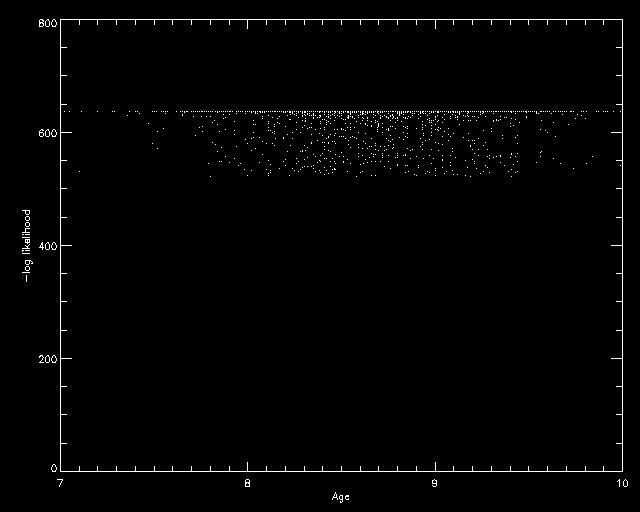
While it now centers around the predicted age, an actual peak doens't really exist. Seems like there is a minimum -log likelihood value, that cuts of under. This is my next problem to fix.

And congratulations to Mary on a beautiful presentation :)

Wednesday, August 18, 2010

No Progress


So, I still have not figured out why my program highly favors really young ages and ignores the turn off and red clump. Obviously the Cross Entropy framework is fine since it worked so well for distance moduli, as you can see the plot of all moduli from the parameters sets versus the corresponding -log likelihood. Yet a lower age always allows a better fit?

I created fake stardata just out of the points from an isochrone, and then it didn't go to zero, but it still undershot. I do not understand what that test might suggest.

Anyway, I believe it is NOT as a result of the membership probability, or the CE framework, the IMF, how I am marginalizing over mass, a mess up in dimensions, how I read in the grid, the few outliers, or how I'm weighing the average of the best points by 1/-log likelihood,